Building an AI Software Factory

The Idea
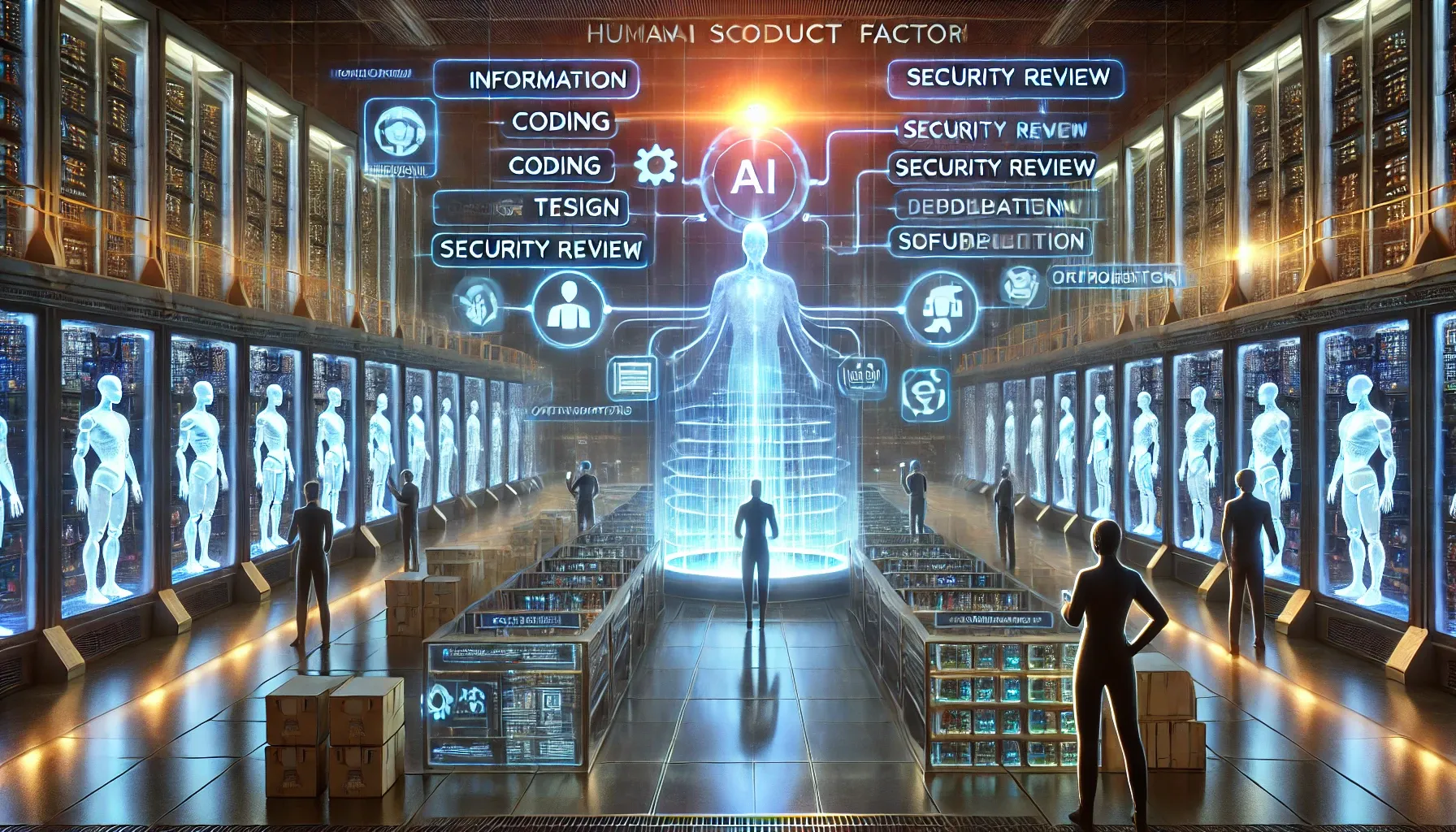
What if you could treat software development like a manufacturing line? Not in the old waterfall sense — but a modern, AI-driven factory where multiple applications are being built, tested, secured, and deployed concurrently by teams of AI agents with human oversight at every critical checkpoint.
That's exactly what my colleagues and I are building right now.
What Is an AI Software Factory?
An AI software factory is an orchestrated environment where AI agents handle the repetitive, parallelizable parts of software development — writing boilerplate, running tests, performing code reviews, generating documentation, scanning for vulnerabilities — while humans focus on architecture, business logic, and final approval.
The key difference from just "using AI tools" is the system-level thinking. It's not one developer with Copilot. It's an infrastructure designed from the ground up to run multiple development pipelines simultaneously, with guardrails, access controls, and audit trails baked in.
Why Now?
Three things converged to make this practical:
- AI coding agents got good enough. Claude, GPT, and others can now write production-quality code, understand large codebases, and follow complex instructions reliably.
- Infrastructure-as-code matured. Spinning up isolated environments for each project or agent is trivial with Terraform, containers, and cloud-native tooling.
- The security and access layer caught up. This is where tools like StrongDM come in.
The Access Problem
When you have multiple AI agents and developers working across multiple applications, the access management problem explodes. Each agent needs database access, API keys, cloud credentials, and SSH access to different environments — and you need to know exactly who (or what) accessed what, when.
StrongDM solves this by providing a unified access layer. Instead of scattering credentials across environment variables and secret managers, you route all infrastructure access through a single control plane. Every connection is authenticated, authorized, logged, and auditable. You can grant an agent temporary access to a staging database for exactly the duration of its task, then revoke it automatically.
For an AI software factory, this is table stakes. You can't have AI agents with standing access to production databases. You need:
- Just-in-time access — agents get credentials only when actively working a task
- Session recording — every database query and SSH command is logged
- Role-based controls — different agents get different access levels based on their function
- Automatic revocation — access expires when the task completes
Our Architecture
Here's the high-level view of what we're building:
The Pipeline
Each application flows through a standardized pipeline:
- Requirements Intake — Human-defined specs and acceptance criteria
- Code Generation — AI agents scaffold and implement features in isolated branches
- Automated Testing — Unit tests, integration tests, and E2E tests run automatically
- Security Review — AI-powered SAST/DAST scanning plus human review for critical findings
- Code Review — AI performs initial review, humans approve final merge
- Deployment — Automated CI/CD to staging, human-gated promotion to production
The Concurrency
The real power is running multiple applications through this pipeline simultaneously. While Application A is in code review, Application B is being scaffolded, and Application C is running security scans. The factory never stops.
Each application gets:
- Its own isolated environment (containers, databases, cloud resources)
- Its own set of AI agents with scoped access
- Its own audit trail
- Shared infrastructure patterns and security policies
The Human Layer
This isn't about replacing developers. It's about amplifying them. A small team can oversee multiple applications in flight because:
- AI handles the 80% that's repetitive and well-defined
- Humans focus on the 20% that requires judgment, creativity, and domain expertise
- Every AI action is reviewable and reversible
- Critical decisions (architecture, security exceptions, production deploys) always require human approval
Key Infrastructure Components
Beyond StrongDM for access management, the factory relies on:
- Terraform — Infrastructure-as-code for spinning up per-project environments
- Docker/Kubernetes — Isolated execution environments for each agent and application
- Git branching strategies — Each AI agent works on isolated branches with PR-based review
- Secret management — GCP Secret Manager / AWS Secrets Manager for credentials, never hardcoded
- Observability — Logging and tracing on every AI agent action for debugging and compliance
- Policy-as-code — OPA or similar for enforcing security and compliance rules programmatically
Lessons So Far
We're still early, but a few things have become clear:
Start with the guardrails, not the agents. It's tempting to jump straight to AI code generation. But if you don't have access controls, audit trails, and isolation in place first, you're building on sand.
Standardize everything. The factory model only works if every application follows the same patterns for project structure, testing, CI/CD, and deployment. Bespoke setups for each app defeats the purpose.
AI agents need context, not just prompts. The agents that work best aren't the ones with the cleverest prompts — they're the ones with the best context: clear specs, well-documented codebases, and access to the right tools.
Human review is the bottleneck, and that's okay. The goal isn't to eliminate human involvement. It's to make sure humans spend their time on decisions that actually matter, not on boilerplate they could review in their sleep.
What's Next
We're actively building this out and learning as we go. The vision is a system where a small team can maintain and evolve a portfolio of applications with AI doing the heavy lifting on implementation while humans steer the ship.
If you're thinking about building something similar, my advice is to start with the infrastructure layer — access management, isolation, and observability — before you worry about which AI model to use. The models will keep getting better. The hard part is the system around them.